

How Entity SEO Changes Modern Search
Authored by: Kelsey Blum – Creative Director | Date Published: January 21, 2026
Search has fundamentally changed. While most businesses are still stuffing keywords into their content, search engines have moved on to something far more sophisticated: understanding entities. At Brand House Marketing, we’ve watched this evolution reshape how brands approach their digital presence, and today I want to break down what entity SEO means for your business.
What exactly is entity SEO?
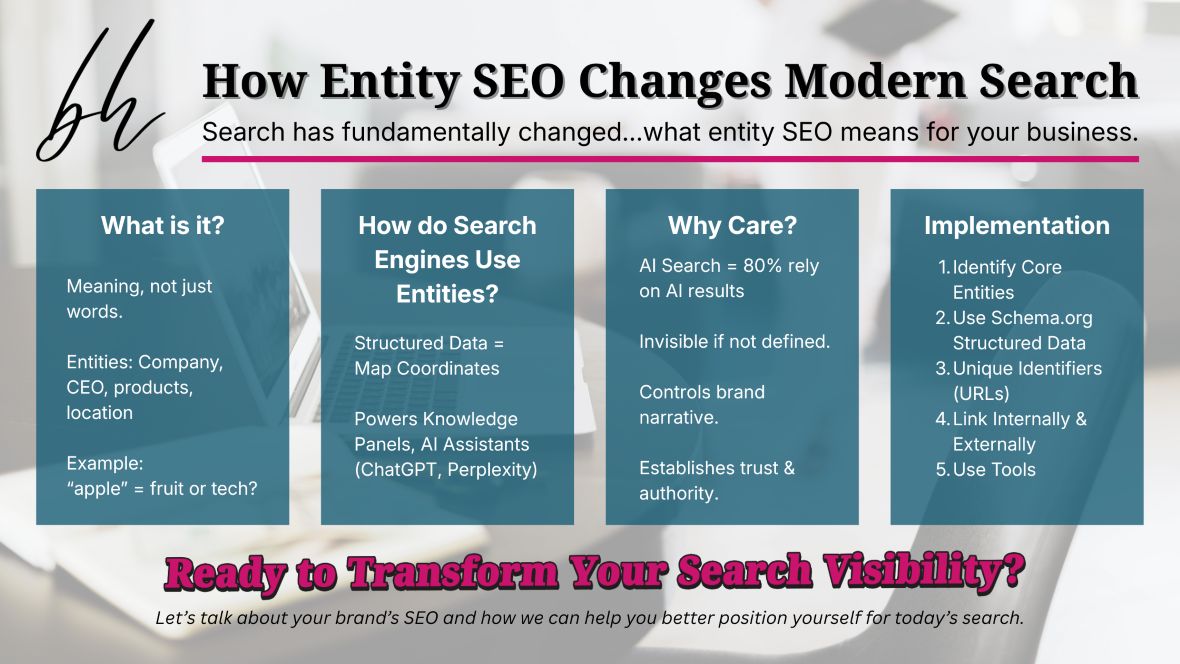
Think of entity SEO as teaching search engines who you are, not just what words you use. An entity is any distinct, identifiable thing: your company, your CEO, your flagship product, or your physical location. Unlike keywords that can mean multiple things depending on context, entities have specific meanings that search engines can verify and understand.
Here’s the difference. If I search “apple,” am I looking for fruit nutrition or the latest iPhone? Search engines use entity recognition to figure that out based on context, user history, and how well websites have defined their entities. That’s why some brands dominate search results while others get lost in the noise.
How do search engines use entities?
Google and other search platforms have built massive knowledge graphs. Databases that map out millions of entities and how they relate to each other. Google’s Knowledge Graph alone contains over 500 billion facts about entities and their relationships. When you define your brand’s entities clearly through structured data, you’re essentially adding your business to this map with exact coordinates.
This is what powers those information-rich Knowledge Panels you see on the right side of Google results. It’s also what enables AI assistants like ChatGPT, Perplexity, and Google’s AI Overview to pull accurate information about your brand. Without proper entity definition, these systems might misidentify you, pull outdated information, or skip you entirely.
Why should my business care about entities?
The shift toward AI-powered search experiences has made entity SEO essential. Research from Bain & Company reveals that 80% of consumers now rely on AI-written results for at least 40% of their searches, fundamentally changing how people discover brands. When someone asks an AI assistant for recommendations or information, these systems rely on structured entity data to provide answers. If your brand’s entities aren’t clearly defined and linked, you’re essentially invisible to AI search.
Beyond visibility, entity SEO gives you control over your brand narrative. For example, when Airbnb implemented entity-based strategies by clearly defining its properties, services, and brand relationships in structured data, search engines displayed its information more accurately in Knowledge Panels and relevant search results, reinforcing a consistent brand image. By clearly defining who you are, what you do, and how you relate to other recognized entities, you’re establishing authority that search engines can verify. This isn’t just about ranking. It’s about being understood correctly across every platform where your customers might find you.
What’s the difference between keyword and entity work?
Traditional keyword SEO focuses on matching the words people type into search boxes. Entity SEO focuses on meaning and relationships. You’re not just targeting “marketing agency.” You’re establishing your organization as a distinct entity with specific services, team members, locations, and areas of expertise.
Keywords can be ambiguous. If your content mentions “mercury,” search engines need additional signals to determine whether you’re discussing the planet, the element, or the automobile brand. Entity markup removes that ambiguity entirely by connecting your content to recognized knowledge bases that define exactly what you mean.
How can I implement entity SEO for my website?
Start by identifying your core entities. For most businesses, this includes your organization itself, key team members, products or services, and physical locations. Each of these should be defined using Schema.org structured data markup.
The critical piece is using unique identifiers for each entity. This means assigning a specific URL or URI that represents that entity across your entire website. When you mention CEO in a blog post, on an About page, or in a product announcement, you’re linking to the same entity definition each time.
Next, connect your entities both internally and externally. Link your team members to your organization, your products to their categories, and your locations to their parent company. Then connect to external knowledge bases like Wikidata or Wikipedia to help search engines verify and disambiguate your entities.
What tools help with entity work?
While you can manually code Schema markup, dynamic tools make entity SEO scalable for businesses with extensive content. Look for solutions that let you define entities once and automatically link them throughout your site as they’re mentioned.
The key is flexibility. Rigid plugins that only offer basic markup templates won’t give you the depth needed for comprehensive entity SEO. You need to customize markup, nest relationships, and maintain consistent entity definitions across your entire digital ecosystem.
Where does entity SEO fit in my marketing approach?
Entity SEO isn’t just a technical SEO tactic; it’s a foundational element of brand architecture. When implemented properly, it creates consistency in how your brand appears across search engines. AI platforms, social media, and any other channel where your business information is displayed.
This consistency builds trust. When Google, ChatGPT, and Perplexity all present the same accurate information about your company, you’re reinforcing your brand authority. It also protects you from misinformation or outdated details appearing in search results.
How does entity SEO prepare my brand for AI search?
AI assistants are becoming primary search interfaces for many users. These systems don’t crawl websites the way traditional search engines do; they pull from structured knowledge bases built on entity relationships. If your brand’s entities aren’t in these systems, you don’t exist in AI-powered search results.
By establishing strong entity foundations now, you’re future-proofing your search presence. However, implementing entity SEO can present challenges, such as accurately identifying all relevant entities, ensuring consistent use of structured data, and maintaining unique entity identifiers across your site. Additionally, organizations may struggle with integrating internal and external knowledge bases, which are key for search engines to verify and disambiguate entities. As search continues to shift toward conversational AI and away from traditional keyword queries, brands with clear and properly maintained entity definitions will maintain visibility, while those that overlook these complexities may struggle to adapt.
Ready to Take Control of Your Brand’s Search Presence?
Entity SEO represents a fundamental shift in how search works, but it’s also an opportunity. Brands that move beyond keyword-based approaches and embrace entity-based strategies are positioning themselves for long-term success in an AI-driven search environment.
At Brand House Marketing, we help businesses implement entity SEO methods that build lasting search authority. From identifying your core entities to deploying advanced Schema markup and establishing knowledge graph presence, we’ll make sure your brand is understood correctly everywhere your customers search.
Want to see how entity SEO can transform your search visibility? Let’s talk about your brand’s entity plan.