

Where High-Growth Firms Put Their Marketing Dollars
Authored by: Kelsey Blum – Creative Director | Date Published: July 29, 2026
If you’ve ever had a partner ask what the firm should be spending on marketing and realized you didn’t have a real number to point to, you’re not alone. Most firms between $5M and $100M in revenue don’t have a real benchmark to work from, just a sense that “we should probably be doing more.” The accounting industry tracks this closely, and the numbers point to a clear answer, along with a pretty big gap between firms that grow fast and firms that don’t. That gap is worth understanding before you set next year’s number, since it changes what a “reasonable” budget looks like once you’re past the $5M mark.
How Much Should an Accounting Firm Spend on Marketing?
The most current answer comes from the Association for Accounting Marketing (AAM). According to AAM’s own reporting on its 2025 data, the average firm now puts 1.68% of revenue toward marketing, including staff compensation. On a $5M firm, that lands around $84,000 a year, covering people, content, design, digital advertising, and events.
That number moves depending on what you count. AAM’s earlier benchmark studies broke spending into “with compensation” and “without compensation” categories, since salaries make up such a large share of most budgets. Firms that separate the two tend to get a clearer read on where the dollars are going, rather than lumping a marketing director’s salary in with ad spend and calling it one line item. For a firm sitting at $5M in revenue, that distinction matters more than it seems. A budget built entirely around one salary looks very different on paper than one that also funds content, ads, and design work on top of that person’s time.
What Percentage of Revenue Do High-Growth Firms Spend on Marketing?
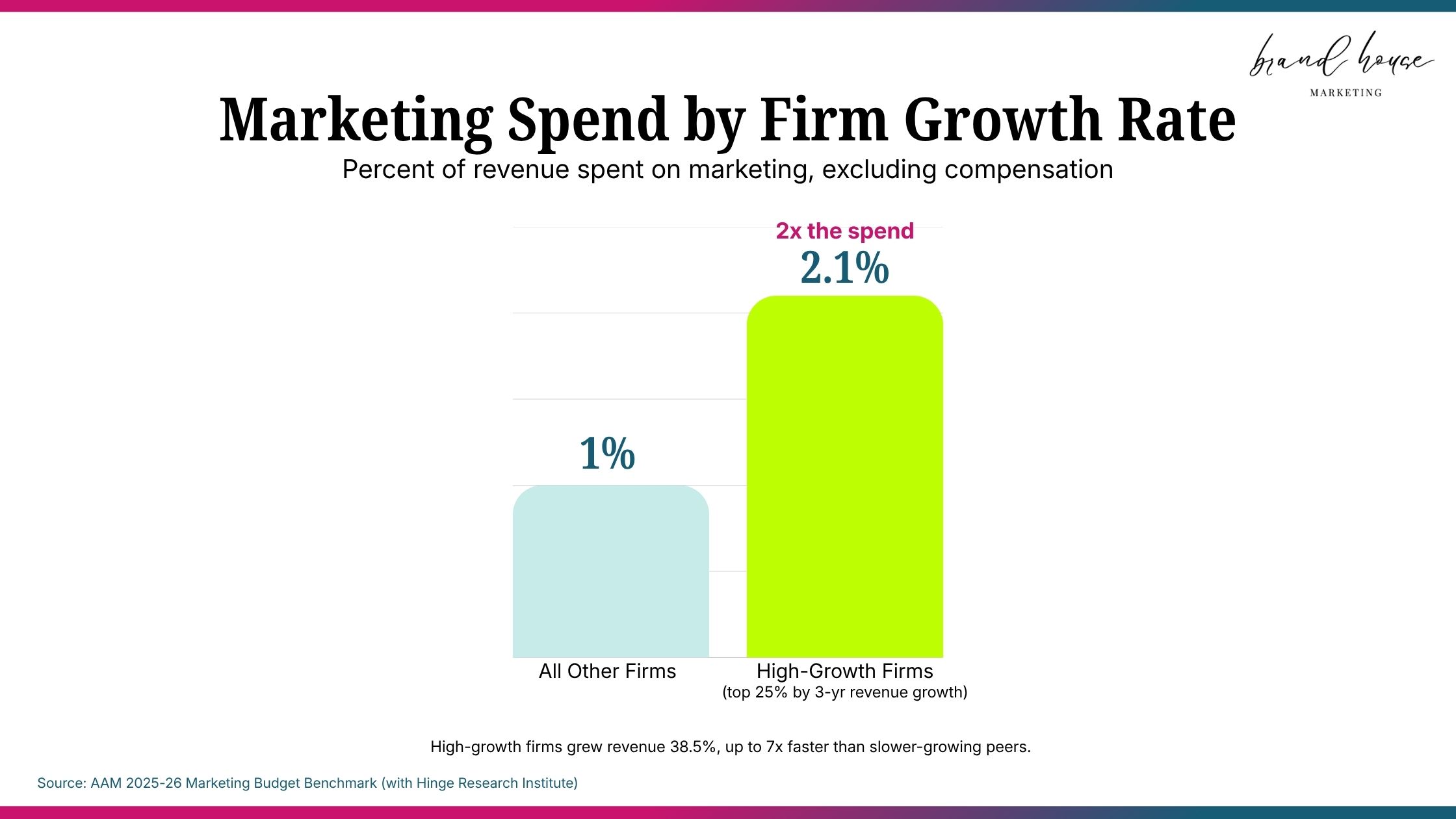
Here’s where it gets interesting for a $5M firm trying to decide how ambitious to be. AAM’s 2025-26 Marketing Budget Benchmark Study, developed with the Hinge Research Institute and based on 87 firms representing more than $16 billion in combined revenue, found that high-growth firms (the top 25% by three-year compound annual growth rate) spend 2.1% of revenue on marketing, excluding compensation. That’s double the 1% spent by everyone else in the sample.
"Attracting and retaining top talent is a critical challenge in the accounting industry, and these firms take the challenge seriously."
The payoff is not small. Those high-growth firms posted revenue growth of 38.5%, up to seven times faster than their slower-growing peers, according to the study. AAM put it plainly:
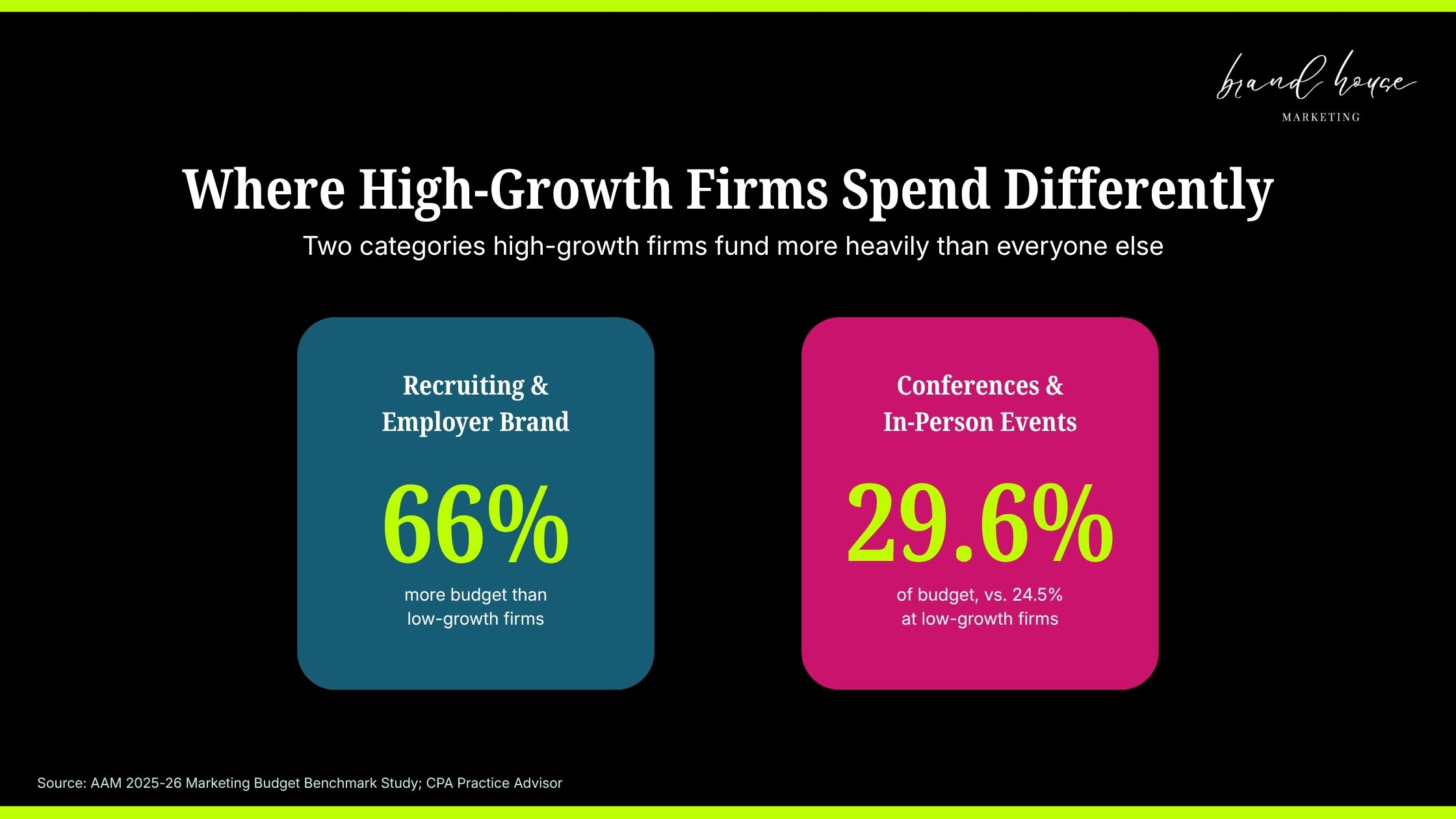
That quote shows up in the context of recruiting spend specifically, which is worth sitting with for a second. High-growth firms put 66% more of their marketing budget into recruiting and employer brand than low-growth firms do. For a firm competing for staff in a tight talent market, marketing dollars and hiring outcomes are more connected than most partners assume.
Does Firm Size Change What You Should Spend?
Yes, and it’s not a straight line. Smaller firms with little name recognition often need to spend a higher percentage of revenue just to build visibility, since they don’t have decades of referrals doing the work for them. As a firm grows and its referral pipeline stabilizes, that percentage can dip. Then, once a firm starts scaling again, adding staff, expanding into new markets, or building out service lines, the percentage tends to climb back up because marketing has to support recruiting, niche positioning, and a bigger digital footprint all at once.
A $5M firm usually sits right at that inflection point. You’re past the “nobody knows we exist” stage but not yet at the size where referrals alone keep the pipeline full. That’s exactly the stage where AAM’s data suggests spending more, not less, tends to pay off.
What Should a $5M Firm's Marketing Budget Include?
Based on AAM’s benchmark categories, a reasonably built budget for a firm this size typically covers:
↳ People and staff time. The largest line-item industry-wide, whether that’s a marketing hire, a fractional resource, or an agency filling the gap.
↳ Content and SEO. Blog content, service pages, and thought leadership that shows up when a business owner searches for a CPA.
↳ Website and digital infrastructure. A site built to convert, not just exist.
↳ Paid digital advertising. A way to fill gaps that content and SEO alone can’t close quickly. ↳ Design and branding. A firm’s visual identity across every touchpoint, from the website to the pitch deck.
↳ Recruiting and employer brand. The category high-growth firms fund 66% more heavily than everyone else.
↳ Conferences and in-person events. The second-largest spending category in the industry, and one high-growth firms lean into the hardest.
For a $5M firm, that list often looks smaller in practice, such as one person covering three or four of these categories, with an agency or outside partner filling in the rest. That’s normal. The benchmark isn’t a checklist every firm needs to staff internally, it’s a picture of where the dollars go once a budget is built out fully.
Where Do High-Growth Firms Spend Differently?
Two things stand out. First, recruiting and employer brand, already covered above. Second, in-person connection. High-growth firms put 29.6% of their marketing budget toward conferences and client events, compared to 24.5% for low-growth firms, a 21% gap. AAM President Laura Metz summed up the pattern:
"Today's high-performing accounting firms are taking a somewhat more balanced approach to marketing"
In other words, the fastest-growing firms aren’t choosing between digital and in-person. They’re funding both, at a higher overall level than everyone else, and treating events as a growth driver rather than a nice-to-have.
How Can Brand House Marketing Help?
Brand House was founded by, and remains an affiliate of, an IPA Top 300 CPA firm. That’s not a marketing claim, it’s the reason our team understands where these percentages go once they turn into a real budget instead of a line on a spreadsheet. Most firms in the $5M to $100M range don’t have the internal bandwidth to run content, SEO, paid ads, design, and recruiting marketing all at once. Usually there’s one person trying to do all of it, or no one at all, while partners assume marketing is happening in the background.
Brand House works alongside firms at this exact stage, whether that means acting as the firm’s full marketing department or filling in around a marketing team that’s already in place. That includes building the content and SEO foundation that shows up when a prospective client searches, developing the employer branding that competes for talent in a tight hiring market, and helping a firm find and own a niche instead of competing as a generalist in a crowded field. Budget percentages only mean something once they’re tied to a plan, and building that plan is where Brand House comes in.
If your firm is trying to figure out where a budget like this should go this year, a conversation with Brand House is a reasonable place to start. Our team has sat on the other side of this exact question, inside a CPA firm, and can help turn a percentage of revenue into a plan that a partner group will sign off on.
Curious how your firm’s current spending compares? Reach out to Brand House Marketing and we’ll help you turn a percentage of revenue into a marketing plan built for a firm your size.